ChatGPT Lost the AI Shopping War. Here’s the One File That Decides If Google Shows Your Store.
In March 2026, OpenAI quietly shut down ChatGPT Instant Checkout. About 12 merchants ever went live on it. The grand vision of ChatGPT as the world’s AI shopping mall lasted less than two years. It ended with barely a whisper and ChatGPT Lost the AI Shopping War.
Meanwhile, something much bigger was already running.
Table of Contents
The Numbers That Should Have Your Attention
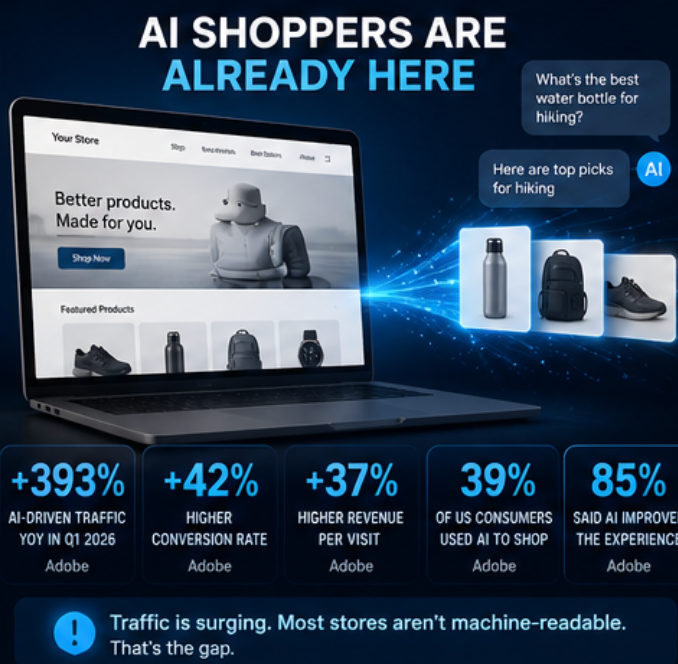
AI-driven traffic to US retail jumped 393% year over year in Q1 2026, according to Adobe. That is not a rounding error. That is a structural shift in how people find and buy products online.
But here is the part most brands are missing: AI-referred shoppers are not just more numerous. They behave differently. They convert 42% better than non-AI traffic. They drive 37% higher revenue per visit. Adobe’s data also shows that 39% of US consumers have now used AI to shop and 85% of them said it improved their experience.
AI shoppers are real, they are already arriving at stores and they spend more when they get there.
The uncomfortable follow-up: Adobe’s same research flags that most retail sites are not “machine-readable.” The traffic surge is happening. The readiness is not.
Why ChatGPT Lost
ChatGPT’s shopping play failed for a structural reason, not a marketing one.
OpenAI tried to bolt commerce onto a conversational AI that had no native product catalog infrastructure. It had no Shopping Graph. It had no merchant onboarding at scale. It had no unified data layer that could reliably pull accurate pricing, availability, and product attributes across millions of SKUs in real time.
The result: a checkout experience that never got past a handful of pilot merchants, discontinued in March 2026. ChatGPT is now explicitly repositioned as discovery-only. It can suggest products. It cannot complete a purchase.
Why ChatGPT Lost the AI Shopping War
Google has been building the infrastructure for AI commerce for years, not months.
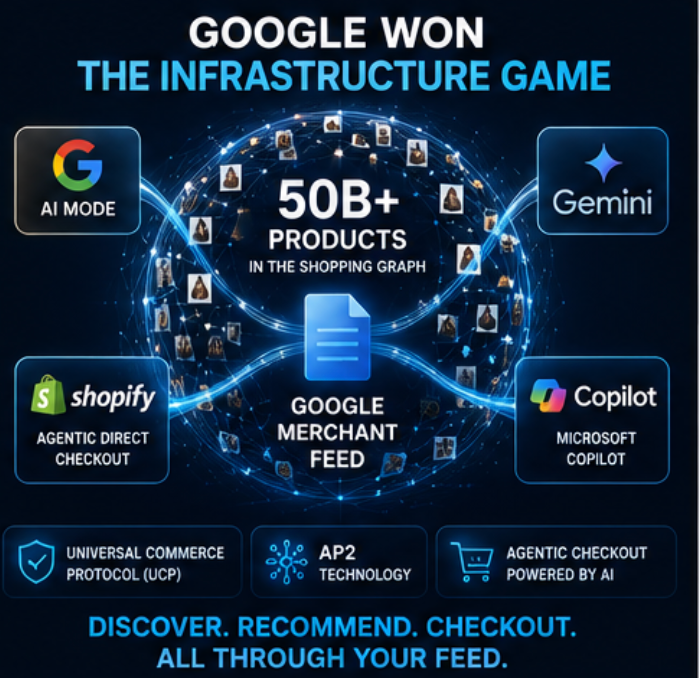
The Shopping Graph contains over 50 billion product listings. It is the largest structured product catalog on the planet, fed continuously by Google Merchant Center. Every product on it is standardized, validated, and machine-readable.
In January 2026, Google launched the Universal Commerce Protocol (UCP) alongside its AP2 technology. Together, these power agentic checkout inside AI Mode and across Gemini. An AI agent can not only discover a product through Google but complete the purchase without the user ever leaving the conversation.
Shopify is already plugged in. Shopify’s agentic direct checkout works with Google AI Mode, Gemini, and Microsoft Copilot. If you’re still deciding whether building your own store is worth it, our guide Why Amazon Sellers Should Build a Shopify Store? explains why owning your commerce infrastructure has become more important than ever.
The infrastructure is live. The checkout is live. The traffic is already arriving.
The Punchline Nobody Talks About
Here is what all of this means in plain terms: Google’s AI shopping engine does not read your theme. It does not read your product description page. It does not care how beautiful your homepage looks. As we explain in What Your Amazon Listing Can’t Teach You About Shopify?, optimizing an Amazon listing is fundamentally different from making a Shopify store understandable to search engines and AI systems.
It reads one file: your product feed.
Everything that determines whether your products appear in AI Mode, whether Gemini recommends them, whether an agent can complete a checkout on your behalf. It all flows through the data in your Merchant Center feed.
If that file is clean, structured and complete, you are visible. If it is not, you are invisible. Not penalized, not ranked lower. Just not there.
What “Machine-Readable” Actually Means
A machine-readable product feed is not complicated in concept, but it is easy to get wrong in practice. These are the five things that matter most in 2026:
1. Valid GTINs Google’s AI systems use the GTIN (barcode) to cross-reference your product against every other listing for the same item. Missing or invalid GTINs make it impossible to verify your product, match it to search intent, or surface it in Shopping Graph results.
2. Correct google_product_category Google’s taxonomy has thousands of categories. Using a vague or wrong one does not trigger an error message. It just means your product gets filed in the wrong place and matched to the wrong queries. Silently.
3. item_group_id on every variant This is the single most common silent killer. When variants of the same product (different sizes, colors, materials) do not share an item_group_id, Google treats them as unrelated products. Worse, disapproval of one variant can take down the entire family. One bad SKU can wipe out a whole product line from your feed.
4. High-resolution images Google updated its minimum to 500×500 pixels in 2026. Images below that threshold are disapproved. The image in your feed does not have to be different from your site. It just has to meet the spec.
5. Feed-to-landing-page consistency If the price, availability, or title in your feed does not match what is on the actual product page, Google flags it as a mismatch. Automated crawlers check this regularly. Discrepancies lead to disapprovals and suppression.
These are not edge cases. They are the most common reasons feeds get suppressed in 2026, and none of them surface an error in your Shopify dashboard. They fail quietly, inside the feed itself.
And that is the real problem. Google does not send you a warning email. It does not pause your account or notify you in the Search Console. It simply stops showing your products. You keep running ads, you keep paying for traffic, and the feed errors sit there invisible until someone actually looks at the file.
The Window Is Still Open, But It Is Closing
The gap between AI traffic growth and machine-readable store readiness is where the real opportunity lives right now. Most brands have not fixed their feeds because nobody told them they needed to. Shopify generates a feed automatically. It does not tell you whether that feed is good.
The brands that close this gap first get cited by AI systems, surfaced in AI Mode, and completed through agentic checkout. The ones that wait get filtered out before a human ever sees them.
This is not about chasing a trend. It is a no-regrets infrastructure fix, the kind that pays dividends regardless of which AI platform becomes dominant next quarter. Feed quality is not a Google Shopping tactic anymore. It is the entry ticket to every AI commerce channel that exists today, and every one that is coming. For brands thinking beyond marketplaces, it’s also a foundational step in How to scale Amazon brand off Amazon.
What to Do Right Now
You do not need to hire a developer or rebuild your catalog. You need to know exactly where your feed stands.
The brands that fix these issues before everyone else are often the same businesses featured in What Successful Amazon Sellers Do Differently?, because they invest in infrastructure before it becomes a competitive necessity.
Most store owners who run the audit find at least two or three issues they had no idea about. Missing GTINs, wrong categories, variant families that were quietly disapproved months ago. It takes 60 seconds to find out.
Our free Merchant Feed Optimizer gives you a graded audit of your Google Merchant feed in 60 seconds. Paste your feed URL or connect Google Merchant Center read-only. We never write anything to your account, full stop. You get a report showing exactly what a machine sees wrong, emailed directly to you.
. You get a report showing exactly what a machine sees wrong, emailed directly to you.
Run the free feed check and see your store the way Google’s AI sees it.
What is a Google Merchant feed?
A Google Merchant feed is a structured data file (usually a spreadsheet or XML file) that lists every product in your store with standardized attributes like title, price, availability, GTIN, and category. Google reads this file to populate Shopping results, AI Mode, and now agentic checkout.
What is agentic commerce?
Agentic commerce refers to AI systems that can complete purchases on a user’s behalf, not just recommend products. Google’s Universal Commerce Protocol and AP2 enable this inside AI Mode and Gemini. Shopify’s agentic direct checkout integrates with these systems.
Why was ChatGPT Instant Checkout discontinued?
OpenAI discontinued ChatGPT Instant Checkout in March 2026. The feature never scaled beyond approximately 12 merchant partners. OpenAI has since repositioned ChatGPT as a discovery tool rather than a transactional one.
How do I know if my feed has errors?
Google Merchant Center surfaces some disapproval, but many feed quality issues like wrong categories, missing item_group_id, and mismatched prices do not produce clear error messages. A dedicated feed audit is the fastest way to see the full picture.

Your Amazon store needs a partner
We build and grow your Shopify DTC business together with Amazon.
Find out how to own your audience and not depend only on Amazon high fees.

Author: Dusan Popovic

From Amazon to Shopify Check list

Best Amazon FBA course 2026

Connect Shopify to Amazon: Complete 2026 guide