AI is rewriting the rules for Amazon sellers
Table of Contents
If there was one theme running through every exchange at the Ecom Mastery Conference in Nashville this year, it was this: AI is no longer a future thing and AI is rewriting the rules for Amazon sellers. It is happening right now, in real businesses, and the sellers who understand that are moving fast.
We were there talking to sellers from across the country, people doing serious volume on Amazon and building DTC brands on Shopify. And what we heard was consistent: “One person can do the job of ten”
That quote came directly from a seller we spoke to on the conference floor — someone who said they use AI daily and rarely find themselves blown away anymore. But even they were impressed by what they saw in Nashville.
The thing that struck them most was not a single tool or tactic. It was the scale of what AI is now enabling in terms of output per person.
The challenge now is no longer whether AI matters, but knowing which tools actually create leverage for your business. For many ecommerce brands, learning How to find and use the right AI tools for ecommerce is becoming a competitive advantage in itself.
Tasks that would previously require a content team, a media buyer, a creative director and a data analyst can now be handled, at least at first pass, by one operator who knows how to work with AI properly.
For ecommerce brands, this has real financial implications. If you are currently running lean and struggling to produce enough content, enough creatives, enough data analysis to compete with larger brands, AI is narrowing that gap faster than most people expected.
AI influencers
One of the sessions that generated the most buzz on the floor was a presentation showing exactly how to build AI influencers for product promotion. Not in a vague, conceptual way but showing the actual workflow, the actual tools and the actual results.
The core idea is that you can now create a fully synthetic persona, a character with a look, a voice, a point of view and deploy that persona to promote your products across social channels. But what made it particularly interesting for the brands we spoke to was the segmentation angle: you do not have to build one AI influencer. You can build multiple, each one calibrated to resonate with a different type of buyer.

Think about what that means for a brand in health, supplements, or pet wellness: categories where the customer profile can vary widely depending on motivation, lifestyle and what they are trying to solve. A 28-year-old training for their first marathon and a 55-year-old managing joint health are both buying your glucosamine. They need to hear a different story. AI influencers make that kind of hyper-personalized storytelling scalable in a way that was simply not possible before.
The reaction from the sellers was telling. One person we spoke to put it simply: “I was like, WOW, this is actually happening already.” Genuine surprise that the future had already arrived was common at this event.
The AI employee conversation
Another theme we heard repeatedly was the shift in how sellers are starting to think about AI — not as software, but as staff. One seller told us their takeaway from the conference was clear: they were going to figure out how to hire their first AI employee.
That framing matters. When you think of AI as a tool, you use it to complete tasks. When you think of it as an employee, you start designing roles, workflow and accountability around it. The brands that are doing the latter are seeing meaningfully different results.

This is especially relevant for Amazon sellers who are building or scaling a Shopify DTC channel. The operational surface area of running two channels in parallel — managing listings, running ads, producing content, handling email flows, analyzing data, running customer service — is significant. AI-assisted operations are not just a productivity boost in that context. They are becoming a structural requirement for competing at the level that serious brands need to compete at.
Claude, Perplexity and the technical shift: AI is rewriting the rules for Amazon sellers
One seller we spoke to was attending specifically to learn how to apply these tools: both to their own business operations and to the way they serve their clients. The motivation was the same as we heard across the board: this stuff is moving fast, and the cost of falling behind is rising.
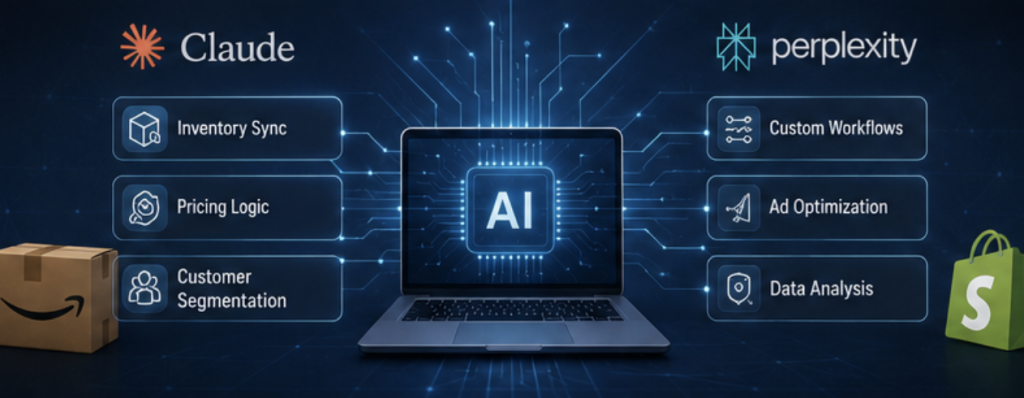
For brands and agencies working across Shopify and Amazon, the implications are concrete. Custom automations, inventory syncs, pricing logic, customer segmentation flows — these are exactly the kinds of workflows where agentic AI starts to deliver genuine ROI, not just interesting demos.
What this means for Amazon sellers building DTC
The common thread across all of these conversations is that AI is compressing the advantage that large brands have historically had over smaller operators. It is making sophisticated marketing, content production, customer segmentation, and operational automation accessible to brands that could never have afforded them before.
Even with the rise of AI-driven discovery and DTC growth, Amazon ranking still remains a critical growth lever for most sellers. Many brands are now combining AI workflows with The Amazon Ranking Strategy That Works in 2026 to improve both visibility and conversion performance.
For Amazon sellers in particular, especially those building or preparing to build a DTC channel, this is an important window. The economics of owning your customer relationship on Shopify have always been compelling in theory: higher margins, repeat-purchase data, no dependency on a single platform’s algorithm or fee structure. AI is now making it operationally realistic to actually capture those economics, even without a large internal team.
But AI alone is not enough. Sellers still need strong operational fundamentals, clear positioning and scalable acquisition systems, which is why many brands continue focusing on foundational strategies like these Top 5 ecommerce tips for owners while integrating AI into their workflows.
Brands that move now, that invest in building the right systems and the right capabilities. will be in a structurally different position than brands that wait.
This is just one conversation from one conference. We’re constantly in the field, talking to sellers, testing what works and sharing what we find. Follow us on LinkedIn so you don’t miss what’s next.


Your Amazon store needs a partner
We build and grow your Shopify DTC business together with Amazon.
Find out how to own your audience and not depend only on Amazon high fees.

Author: Dusan Popovic

From Amazon to Shopify Check list

Best Amazon FBA course 2026

Connect Shopify to Amazon: Complete 2026 guide