Why Every Amazon Seller Should Be on Shopify: Insights from Amazing Days Sofia
Table of Contents
At Amazing Days in Sofia, one of Europe’s growing Amazon seller conferences, we sat down with Zach Seitz, founder of a full-service Amazon advertising agency, to talk about the shifts reshaping the industry and the big question Why Every Amazon Seller Should Be on Shopify? His answers were direct, experience-backed and worth every Amazon seller’s attention.
The Two Problems That Keep Amazon Sellers Up at Night

Ask any Amazon advertising specialist what sellers struggle with most, and you’ll get a consistent answer. Zach didn’t hesitate: ranking, advertising and inventory management are the core pain points he encounters every day with his clients.
These aren’t new problems. But they’re intensifying. As Amazon’s marketplace grows more competitive, the cost of staying visible goes up. PPC campaigns require more strategic management. Inventory miscalculations, running out of stock or overordering, can tank a product’s ranking in ways that take months to recover from.
What makes these problems especially dangerous is the dependency they create. When your entire business lives on Amazon, every algorithm update, policy change, or account suspension becomes an existential threat. You’re not running a business so much as renting space inside someone else’s. And the landlord can change the terms at any time.
Sellers who have been in the game for more than a few years have seen it happen. A ranking that took 18 months to build, wiped out in days. An advertising strategy that worked perfectly for two years, disrupted by a platform update. The problem isn’t that Amazon is a bad channel, it’s an extraordinary one, but no single channel should carry the full weight of a business.
The Lesson Sellers Learn the Hard Way
When asked whether Amazon sellers should also be selling on Shopify, Zach was unequivocal: “Yes, 100%. Never put all your eggs into the same basket, especially with Amazon.”
He wasn’t speaking theoretically. “Many of the sellers I work with, they already learned this in a hard way,” he said.
This is one of the most consistent patterns we see at Byteout. Amazon sellers who have built strong, profitable businesses suddenly find themselves exposed, a suspended listing, a copycat hijacking their product page, a category policy change; and they have no fallback. No customer list. No owned channel. No brand that exists outside of Amazon’s ecosystem.
The exposure is often invisible until it isn’t. Revenue looks stable. Reviews are strong. Everything seems fine. Then something changes on Amazon’s end, not yours and the fragility becomes impossible to ignore.
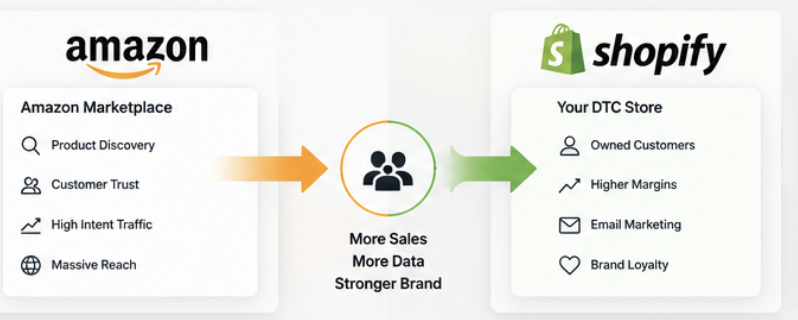
Shopify changes that equation entirely. A DTC store gives sellers something Amazon structurally cannot: ownership. Ownership of the customer relationship, the data, the brand experience, and the revenue channel itself. When you have a Shopify store with an active email list and returning customers, a disruption on Amazon is a problem to solve, not a crisis that threatens the whole business.
But owning the customer relationship is only the first step. Many brands still lose long-term value because they ignore retention and post-purchase experience, which is exactly The #1 mistake brands make after a customer buys.
What’s Changing Fastest in the Amazon Ecosystem
Beyond the multi-channel conversation, Zach pointed to something accelerating across the entire Amazon landscape: AI adoption.
“Advertising, the utilization of AI in different ways, image creation, creative connections, influencer marketing,” he listed. These aren’t future trends, they’re happening now and the sellers who are moving quickly are gaining a real edge.
AI-generated product imagery is getting sophisticated enough to test multiple visual angles at scale. Sellers are running dozens of creative variations, different backgrounds, lifestyle contexts, feature callouts, that would have required a full photo shoot budget just two years ago. The ones doing this well are seeing measurable improvements in conversion rates without proportional increases in cost.
AI tools are also being used to optimize listing copy, predict bid strategies, and identify keyword opportunities faster than any manual process could. What used to take an experienced analyst a full week can now be surfaced in hours. That doesn’t mean the analyst is obsolete—strategic judgment still matters enormously—but the speed advantage is real and compounding.
Influencer marketing is another area shifting fast. Once reserved for brands with significant budgets, it’s becoming more accessible as AI tools help with creator discovery, outreach personalization, and performance tracking. Amazon sellers are increasingly using influencer content not just for awareness but as direct conversion assets, content that feeds both their Amazon listings and their Shopify stores.

The Skills You’ve Built on Amazon Travel With You
The implication for sellers thinking about a Shopify store is significant, and often underestimated. The skills and tools being developed inside the Amazon ecosystem, AI-powered creative, performance advertising, data-driven inventory planning, influencer partnerships, translate directly to DTC.
A seller who has learned to use AI for image creation and split-testing on Amazon can immediately apply that capability to building a compelling Shopify storefront. A seller who has mastered PPC bidding on Amazon has a head start on Meta and Google advertising. The operational muscle built on Amazon is genuinely transferable.
For sellers preparing to make that transition, having a structured From Amazon to Shopify Check list can help simplify the move and avoid common operational gaps.
What changes on Shopify is the context and the ceiling. You’re no longer optimizing within Amazon’s rules, you’re building the rules. The brand voice, the customer journey, the post-purchase experience, the loyalty mechanics: all of it is yours to design.Ž
This level of flexibility becomes especially powerful when brands start exploring Checkout Extensibility for Amazon-to-DTC Brands: What Shopify Lets You Do That Amazon Never Will, allowing them to customize the buying experience far beyond Amazon’s limitations
From Amazon Seller to Brand Owner
The conversation with Zach illustrates something Byteout sees consistently: the most successful Amazon sellers aren’t just operators, they’re in the process of becoming brand owners, whether they know it yet or not.
The Amazon platform helped them find product-market fit. It validated demand. It built cash flow. But the ceiling on Amazon is real. Margins get squeezed by rising ad costs. Brand identity is constrained by marketplace rules. Customer loyalty is nearly impossible to build when Amazon owns the post-purchase relationship.
Shopify is where that ceiling gets removed. It’s where you can build an email list, control the unboxing experience, run a loyalty program, and tell your brand story in a way that Amazon’s template-driven product pages will never allow. It’s where a product business becomes a brand, with equity, with community, and with a direct line to the customers who love what you sell.
The path isn’t about abandoning Amazon. Instead, the goal is learning How to scale Amazon brand off Amazon while still leveraging Amazon as a powerful acquisition and validation channel. It’s about using Amazon as the engine that funds and validates a brand that you actually own. The two channels work better together than either does alone: Amazon drives discovery and volume, Shopify builds loyalty and margin.
Why Every Amazon Seller Should Be on Shopify: the takeaway
Zach Seitz runs an agency that lives inside the Amazon ecosystem every day. When someone in that position says “never put all your eggs in one basket” and points to AI as the fastest-changing force in space, it’s worth listening.
The sellers who will win over the next five years aren’t the ones who master Amazon alone. They’re the ones who use their Amazon success as a launchpad to build something bigger: a real brand, with real customers, on a platform they control.
If you’re an Amazon seller thinking about that next step, Byteout helps you make the move to Shopify without losing what’s working. That’s exactly what we do.
Byteout is a Shopify-certified ecommerce agency specializing in helping Amazon sellers build DTC brands. With 200+ projects and 15 years of experience, we turn Amazon success into brand ownership. Reach out and lets book free consultations.


Your Amazon store needs a partner
We build and grow your Shopify DTC business together with Amazon.
Find out how to own your audience and not depend only on Amazon high fees.

Author: Dusan Popovic

From Amazon to Shopify Check list

Best Amazon FBA course 2026

Connect Shopify to Amazon: Complete 2026 guide