Selling on Shopify and Amazon: Smart ecommerce strategy in 2026
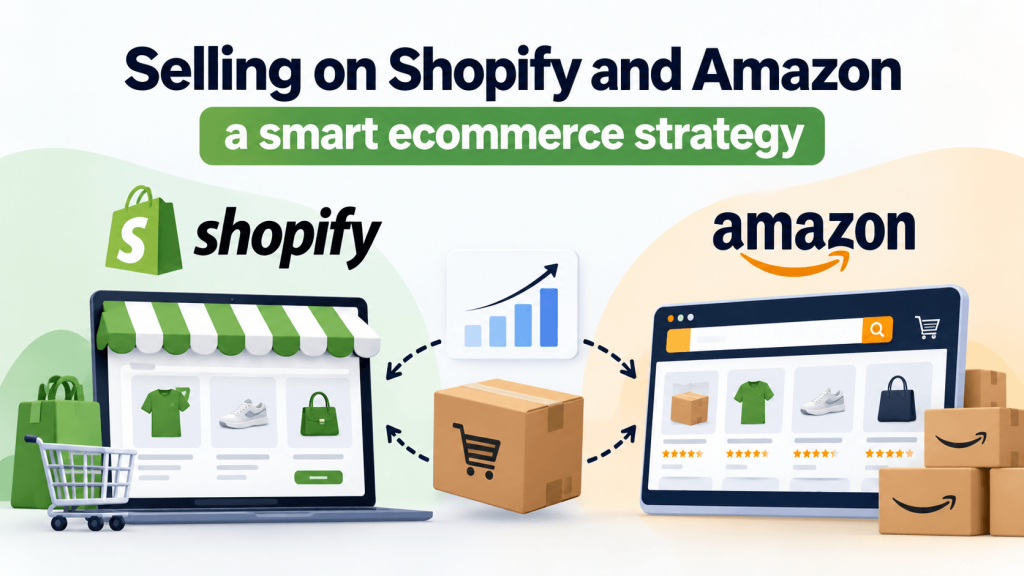
Selling on Shopify and Amazon works best when each platform has a different job. Amazon is where new customers find you. Shopify is where you keep them, through subscriptions, bundles, email, and the customer data Amazon never shares. Manage the two as one ecommerce business, with aligned pricing and one inventory pool, and your online store lifts Amazon sales instead of competing with them.
A few years ago the question was “Shopify vs Amazon: which one?” In 2026 the established brands we partner with ask a different one: how do we sell on both platforms without doubling the workload or cannibalizing our best ASINs? This guide answers that, step by step.
Key takeaways
- Give each platform a job. Amazon handles discovery and volume. Shopify handles retention, profit on repeat orders, and brand identity.
- Don’t undercut Amazon on the same SKU. Win direct customers with bundles, subscriptions, and exclusives, not lower prices.
- One inventory pool is enough. Amazon Multi-Channel Fulfillment (MCF) can ship your Shopify orders from the same FBA stock.
- Your own marketing helps Amazon too. External ads that convert on Amazon earn a Brand Referral Bonus that averages around 10% of those sales.
- AI shopping makes a brand website more important. AI assistants can only recommend what they can read about you, and your own online store is the part you control.
Should you sell on Amazon or Shopify in 2026?
If you are an established Amazon seller in a repeat-purchase category, the answer is both. Amazon and Shopify are not competing options. They are two ecommerce platforms doing different jobs in the same business. The key differences come down to who owns the customer and what each sale costs. If you are still validating a product, start by selling on Amazon, where the demand already exists, and add Shopify once you have a product people buy again. Why Shopify? It is one of the most developed ecommerce platforms for brands that want to own the customer relationship. For a deeper head-to-head, see our Amazon FBA vs Shopify comparison.
| Amazon | Shopify (your online store) | |
|---|---|---|
| Main job | Discovery, new-customer acquisition, volume | Retention, repeat purchase, profit, brand identity |
| Who owns the customer | Amazon | You |
| Customer information | Order details only, no marketing contact | Full first-party data: email, SMS, purchase history, on-site behavior |
| What it costs to sell | Professional seller account fee each month, plus referral, FBA, and advertising fees. Marketplace Pulse estimated Amazon’s all-in take passed 50% of seller revenue | Monthly plan, payment processing or transaction fees, third-party apps, and your own customer acquisition |
| Shipping and logistics | FBA handles storage, fast Prime shipping, and returns | Your choice: Amazon MCF, a 3PL, or in-house shipping |
| Visibility and competition | Access to a massive built-in audience, with competitors on every product page | No competitors on the page, but you bring the visitors |
| Repeat-purchase features | Subscribe & Save within Amazon’s rules | Custom subscriptions, build-your-own bundles, loyalty, lifecycle email |
| Brand control | A+ Content and Brand Store templates | Complete control of design, content, and checkout experience |
| AI discovery | Rufus reads your listing, reviews, and Q&A | ChatGPT, Gemini, Perplexity, and Google AI Mode can read and cite your website |
Pros and cons of selling on both platforms
Benefits:
- Reach and ownership at the same time: Amazon’s audience plus a customer base and customer relationships you own.
- Less platform risk. A policy change, suspension, or fee increase on one marketplace no longer threatens the whole business.
- Better profit on repeat orders, because a returning customer on your own store doesn’t carry referral fees.
- First-party data you can use for email, SMS, product development, and long-term planning.
- Full control of branding and the customer experience, from product pages to checkout.
- Flexibility to test offers, bundles, and pricing models you can’t run on Amazon.
Trade-offs:
- More management: inventory, product listings, pricing, and customer service across two platforms.
- Acquisition costs on Shopify, since nobody stumbles onto your online store by accident.
- Integration tools, and the time it takes to set them up and maintain them.
- Two sets of fees and reports to reconcile.
The trade-offs are real, but they are operational problems with known solutions. The benefits are strategic. That is why most seven-figure Amazon brands end up on both. Pattern makes a similar case for growing a brand with multichannel selling.
How do Amazon and Shopify work together?
Think of it as two pillars in one business. One side feeds the other’s growth.
- Amazon brings customers in. Its built-in traffic is the advantage no online store can match: for millions of US shoppers it is the default place to search for a product. People who have never heard of your brand find you through marketplace search, Sponsored Products, and Rufus.
- Shopify makes them yours. Customers who trust your brand come back to your online store for the second, third, and tenth order, when you give them a reason to: a subscribe-and-save discount, a bundle Amazon can’t offer, loyalty rewards, or products you only sell direct.
- The halo runs both ways. When you advertise off Amazon (Meta, Google, TikTok, creators, email), some of those shoppers will still buy on Amazon because it feels familiar. That is fine. Your branded searches grow, listing conversion improves, and you earn a fee credit for the visitors you sent.
In our own client projects we have seen DTC campaigns produce a measurable Amazon revenue lift within the first 30 to 60 days, often as large as the DTC revenue itself. A Shopify store done right doesn’t replace Amazon revenue. It lifts it.
Will a Shopify store cannibalize my Amazon sales?
Not if you plan pricing and catalog before launch. Cannibalization happens when your Shopify store sells the same thing as Amazon for less. Three rules prevent it:
- Keep price parity on core SKUs. Amazon compares your prices against other websites. If your Shopify price is lower, your listing can lose the Featured Offer (Buy Box), which hurts the platform that still pays the bills.
- Compete on value, not discounts. Give your online store unique offers Amazon handles poorly: flexible subscriptions, build-your-own bundles, larger sizes, starter kits, samples, and quizzes.
- Measure the business, not the platform. Track blended revenue, blended customer acquisition cost, and total contribution margin. A DTC campaign that “only” sells on Amazon is still paying off.
Want to see how this goes wrong in practice? Read the Amazon to Shopify mistakes Redditors warn about.
How to sell on Shopify and Amazon without doubling the work
Selling on two platforms is not running two businesses. It is one business with two sales channels. These are the eight steps we follow with Amazon brands.
1. Assign platform roles and choose your DTC catalog
Decide what Amazon is for (acquisition and volume on hero SKUs) and what Shopify is for (repeat purchase, bundles, the full range). Not every one of your Amazon products belongs on Shopify, and some offers should live only on your online store. This is a strategy decision before it is a development decision.
2. Set pricing rules
Match Amazon on shared SKUs. Use subscribe-and-save discounts, bundle pricing, and member perks to make your store the better deal for repeat buyers without undercutting your listing.
3. Run one inventory pool
You don’t need to split inventory. Amazon’s free Amazon MCF: US Fulfillment app sends your Shopify orders to Amazon, which picks, packs, and delivers them from your FBA inventory. Shopify’s old built-in FBA integration ended on March 31, 2023, so Shopify merchants now use an app like this instead. Shopify’s own guide to Multi-Channel Fulfillment by Amazon covers the setup. MCF can ship in unbranded packaging, and Amazon updates MCF fees every year, so check current rates in Seller Central. If you need custom unboxing, kitting, or branded inserts, a 3PL is usually the better logistics partner.
4. Sync inventory and product listings
Integrating the two platforms means a sale on one updates inventory on the other. For the Shopify Amazon integration itself, including how to connect the accounts and which tools to use, see our complete guide to connecting Shopify to Amazon.
5. Set up the retention engine
For consumable products like supplements, beauty, and pet wellness, DTC pays back on the second order, not the first. Set up email and SMS flows, subscriptions, replenishment reminders timed to how long a product lasts, and a loyalty program that grows repeat customers. This is where your customer lifetime value grows.
6. Drive your own traffic, and get paid when it converts on Amazon
Create demand off Amazon with paid social, search ads, creators, SEO, and email. When you send some of that traffic to your Amazon listings with Amazon Attribution tags, Amazon’s Brand Referral Bonus pays back an average of about 10% of those sales as a credit against referral fees. It requires Brand Registry.
7. Stay inside Amazon’s rules
You can’t use Buyer-Seller Messaging or package inserts to send Amazon customers to your website. Earn your DTC audience from demand you create yourself, not by moving marketplace buyers. Breaking this policy puts your seller account at risk, and that is never worth it.
8. Manage both platforms from one view
Report Amazon and Shopify together: total revenue, blended acquisition cost, repeat rate, and contribution margin by platform. Decisions made from one platform’s dashboard are how brands accidentally cut the campaigns that were growing Amazon.
What changed in 2026: AI shopping assistants
Online shoppers now ask AI before they search. Adobe reported that visits from generative AI tools to US retail websites rose 693.4% year over year during the 2025 holiday season. Inside Amazon, more than 300 million customers used Rufus, Amazon’s shopping assistant, in 2025.
This matters for selling on both platforms in two ways. On Amazon, Rufus reads your listing, reviews, and Q&A, so listing quality now shapes AI answers. Off Amazon, assistants like ChatGPT, Gemini, Perplexity, and Google AI Mode form their picture of your brand from what they can read across the web. Your own site is the part of that picture you control. A brand that only exists as Amazon listings is easy for an AI to swap for a competitor. We cover this in more depth in the brand moat for Amazon sellers in the agentic era.
Is selling on both right for your brand?
You are a good fit if:
- Your Amazon business is established and consistent, typically seven figures or more.
- Customers buy your product again (supplements, beauty, skincare, pet wellness, consumables).
- Your gross profit can fund DTC acquisition while retention builds up.
- People already search for your brand by name.
- You have the team, or a partner, to handle email, retention, and day-to-day operations.
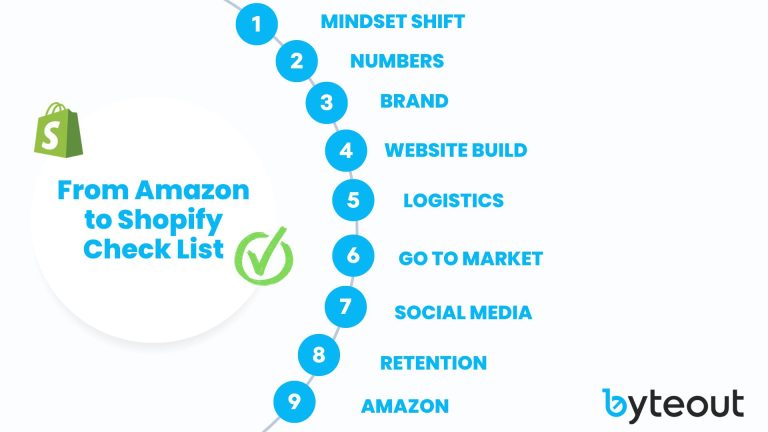
Wait if: you are still validating the product, your margins are thin, or your product is a one-time purchase with no reason to come back. Not sure? Start with should Amazon sellers also sell on Shopify? and our Amazon to Shopify checklist.
Frequently asked questions
Can I use the same inventory for Amazon and Shopify orders?
Yes. With Amazon Multi-Channel Fulfillment (MCF), you keep all stock in Amazon’s warehouses and Amazon ships your Shopify orders from the same inventory. Inventory sync keeps quantities accurate on both platforms.
Can Amazon FBA fulfill my Shopify orders?
Yes, through MCF. Amazon’s free Amazon MCF: US Fulfillment app for Shopify routes orders to Amazon, which picks, packs, and ships them, with unbranded packaging available. You pay per-unit MCF fees, which Amazon updates each year.
How do returns work for Shopify orders fulfilled by Amazon?
You start the return, not Amazon. Create a return authorization for the MCF order in Seller Central, or use a returns tool that integrates with MCF. The item goes back to an Amazon fulfillment center, and sellable units go back into your inventory. Amazon’s MCF return labels are not prepaid by default, so decide whether you cover return shipping for your customers.
Will selling on Shopify hurt my Amazon ranking?
No, a Shopify store does not hurt your Amazon ranking by itself. The risk is pricing: if your store sells the same SKU for less, your listing can lose the Featured Offer. Off-Amazon visitors who convert on Amazon usually help sales velocity and branded search.
Can I send my Amazon customers to my Shopify store?
No. Amazon’s policies prohibit using Buyer-Seller Messaging or package inserts to direct customers to your own website. Win DTC customers from demand you create yourself.
Should I add Buy with Prime to my Shopify store?
It is worth testing. Buy with Prime shows the Prime badge and delivery promise on your own online store, using Amazon’s checkout and fulfillment service. Test it on hero SKUs and compare conversion rate and fees against your standard checkout before rolling it out.
How long does it take to launch a Shopify store if I already sell on Amazon?
A focused launch typically takes 4 to 12 weeks. Reusing strong Amazon content, images, and reviews keeps it at the short end. Custom bundles, subscriptions, and integrations push it toward the long end.
Does Byteout build Shopify stores for Amazon sellers?
Yes, that is our specialty. We work with established Amazon brands in health, beauty, supplements, and pet wellness, covering ecommerce strategy, the Shopify build, Amazon and fulfillment integrations, retention, and ongoing support. See how we build Shopify stores for Amazon sellers.
The bottom line
FBA is still the best engine for reaching new customers at scale. But in 2026, a brand that only lives on Amazon is renting its customers, its data, and its future. Selling on Shopify and Amazon together gives you reach and ownership: Amazon brings customers in, and your online store makes them yours.
If you are an established Amazon brand ready to add the second pillar, see how we work with Amazon sellers or book a free strategy call. Prefer to learn first? Our free Amazon FBA to DTC course walks through the whole process.
Free course
Amazon to Shopify, step by step
Five short video lessons for Amazon sellers building their own store. Free, no call needed.
Watch the free course