How to scale your eCommerce brand
Table of Contents
If you ever asked yourself how to scale your eCommerce brand, interview with AJ Saunders is a must watch! Many founders find success on Amazon, hitting that enviable $1M run rate, only to realize that what got them there won’t necessarily take them to $10M.
AJ Saunders shared his framework for navigating the messy middle of e-commerce growth. From maintaining a “startup scrappiness” to building a team that actually communicates. In this blog we break down parts of the interview.
Introduction to E-commerce scaling
Scaling is more than just increasing your ad spend, it’s about widening your customer base while maintaining profitability. AJ highlights that the journey usually starts with a single, powerful channel. Whether it’s Amazon, Walmart, or a dedicated DTC site, reaching the first million is often about mastering one offer for one specific customer type (ICP).
However, true scaling begins when you realize the limitations of a “closed ecosystem.” Amazon is a powerhouse for sales, but it doesn’t give away gold stars or customer data. To scale effectively, you must find ways to encourage customers to interact with your brand across multiple touchpoints, allowing you to own the relationship, the email address and the long-term value of the shopper.
Understanding the business life cycle
Every e-commerce venture moves through four distinct stages: Startup, Scale, Maturity and Decline.
- The Startup Phase: This is the “scrappy” phase. Success here depends on focus. AJ notes that you can hit the $1M mark through a single channel with a single winning offer. The danger? Many founders rush this stage and do things “poorly or badly,” creating a weak foundation that hampers future growth.
- The Scale Phase: This is where you transition from one channel to many. It requires moving from a “narcissistic” focus on one direction to a more methodical approach to market expansion.
- Maturity & Decline: These stages require a shift toward operational excellence and innovation to prevent the brand from becoming stagnant.
The key takeaway for any founder is to identify exactly where they sit on this curve. If you are under $1M, your job isn’t to be everywhere, it’s to do one thing exceptionally well before earning the right to scale.
Strategies for multi channel expansion
When a seller decides to grow beyond Amazon, the temptation is to “bet the house” on a shiny new DTC site. AJ warns against this. Instead of spending $30,000 upfront on a high-end setup with complex 3PLs and expensive tech stacks, he advocates for a methodical, scrappy approach.
Think like a startup again:
- Test before you invest: Can you throw up a simple site over a weekend to test demand?
- The “Single SKU” strategy: Instead of moving your entire catalog, try getting a single SKU into Walmart or TikTok Shop.
- The Ralph Lauren effect: Expansion shouldn’t cannibalize your primary channel. Just as Ralph Lauren opened boutiques to show how his brand should be experienced, ultimately doubling his sales in department stores, your DTC site should enhance your Amazon presence, not replace it.
The goal of multi-channel expansion is simple: either get people to buy more or attract entirely new clients. If you can do both without over-leveraging your capital, you’ve found the best way of scaling.
Identifying Gaps and When to Seek Help
Scaling stops being about your hard work and starts being about identifying where you are the bottleneck. According to AJ, the signal to hire isn’t a gut feeling, it’s a visible time gap in your daily operations.
“Do you have three hours a day to do your social media properly? It becomes quite obvious because you’ll get to the end of the week and think, Oh, we haven’t actually posted for two days.”
If you are working 50 hours a day, 7 days a week, you don’t have the capacity to grow a new channel. To break through, you must:
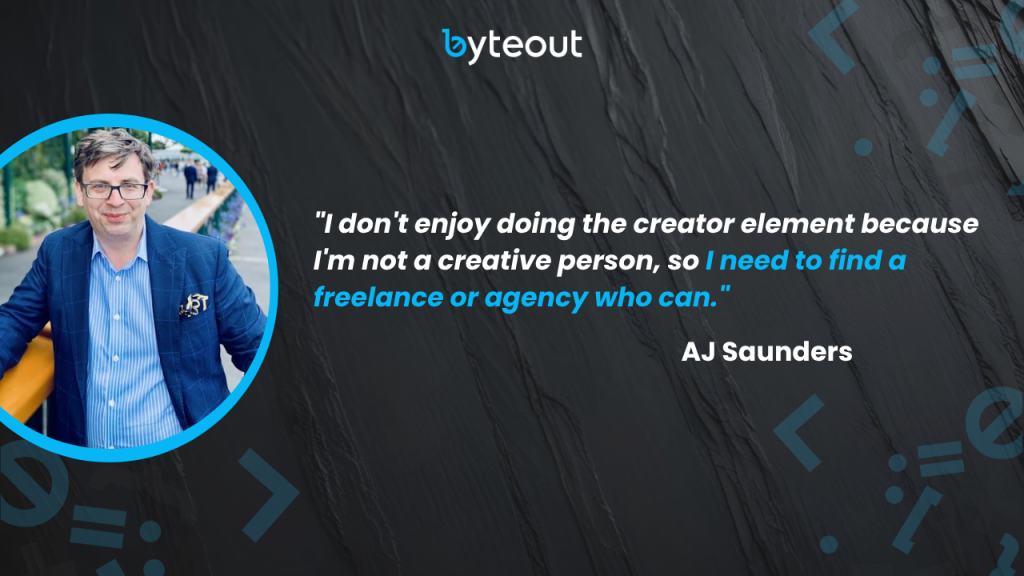
- Audit your energy: Identify what you enjoy versus what you neglect. AJ admits: “I don’t enjoy doing the creator element because I’m not a creative person, so I need to find a freelance or agency who can.”
- Focus on the “return on dollar”: Hire where it enables you to get $2 to $5 back for every $1 spent.
- In-house vs Agency: Build an internal team or a competent CMO only when you need someone to manage the “silos” of different agencies toward a common goal.
Building and Managing Effective Teams
Building a team isn’t about hiring hands.It’s about hiring experts who understand how to coexist. AJ’s rule for internal teams is simple: limit the fluff and focus on the output.
“If the average person sits in meetings for five hours a day, they’ve only got two and a half hours of actual work time. That is not enough to get anything substantially done.”
To keep the machine running, AJ recommends a Pyramid KPI Model:
- Top Tier: 3 Organizational KPIs (e.g., Revenue Growth, Customer Acquisition, Profit).
- Middle Tier: 3 KPIs for leadership (CMO, COO) that tie directly back to the top.
- Bottom Tier: 3 KPIs per role.
This ensures every single employee is responsible for only three metrics that have a direct impact on the person above them. As AJ puts it, this structure “cuts out the idiocy of people who want to look busy instead of being productive.”
Fostering Collaboration Among Stakeholders
Managing multiple agencies and employees often leads to a game where everyone points at someone else’s department. AJ’s approach is to treat everyone as a collective team focused on a single commercial output, like hitting $10M in sales.
“There’s no room for ego. There’s no room for point-scoring or finger-pointing. We as multiple agencies have to work together collectively to get the outcome we’ve agreed with the client.”
In our interview you can see what AJ suggests to keep everyone accountable.
Conclusion: How to scale your eCommerce brand?
Scaling an e-commerce business beyond Amazon isn’t about luck, it’s about moving from a “scrappy” founder to a “commercial” leader. It requires a shift from doing everything yourself to managing a pyramid of KPIs and a team of experts who actually talk to each other.
As AJ puts it, when the “house is on fire,” you don’t want someone who says, “I’m not a firefighter, I’m going to the pub.” You want a team with the integrity to grab a bucket and solve the problem. Keep your operations lean, your KPIs simple, and your decisions strictly commercial, and the path from $1M to $10M becomes a matter of execution, not guesswork.
If you want to hear the full breakdown of these strategies, go watch the entire interview with AJ. There is no substitute for hearing these insights directly from someone who has built and scaled multiple 7-figure brands.
If you feel like you’re hitting a bottleneck, struggling with agency accountability, or unsure how to bridge the gap between Amazon and DTC, we can help. Let’s talk!


Your Amazon store needs a partner
We build and grow your Shopify DTC business together with Amazon.
Find out how to own your audience and not depend only on Amazon high fees.

Author: Dusan Popovic

From Amazon to Shopify Check list

Best Amazon FBA course 2026

Connect Shopify to Amazon: Complete 2026 guide